Here is a gallery of photos from Romania! Blogs follow below …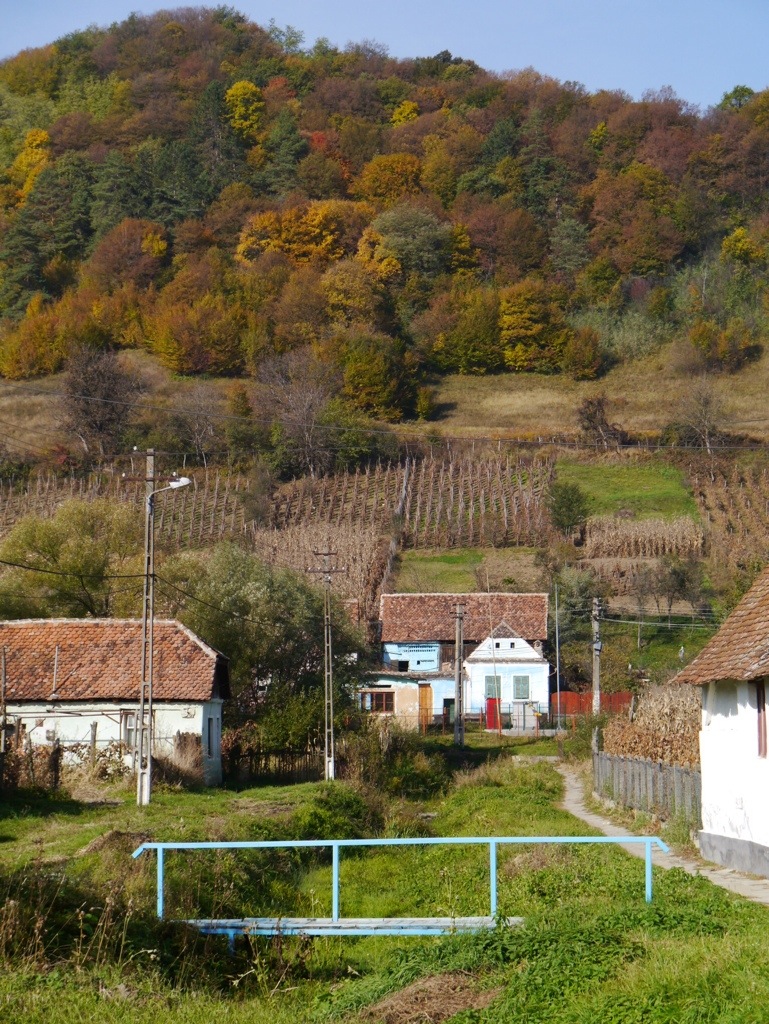
Biertan and Sighisoara
October 8-9, 2013
Though many aspects of Romanian life have quickly changed since the fall of Communism, there are large swaths of the country that are relatively untouched by recent social and economic transformations. For a glimpse into Romania’s past, look no further than rural Transylvania, where villagers still live off the land using traditional methods (as in, “honey, please go outside and cut some wheat with the scythe so we can bake bread to serve with the pig you torched this morning”).
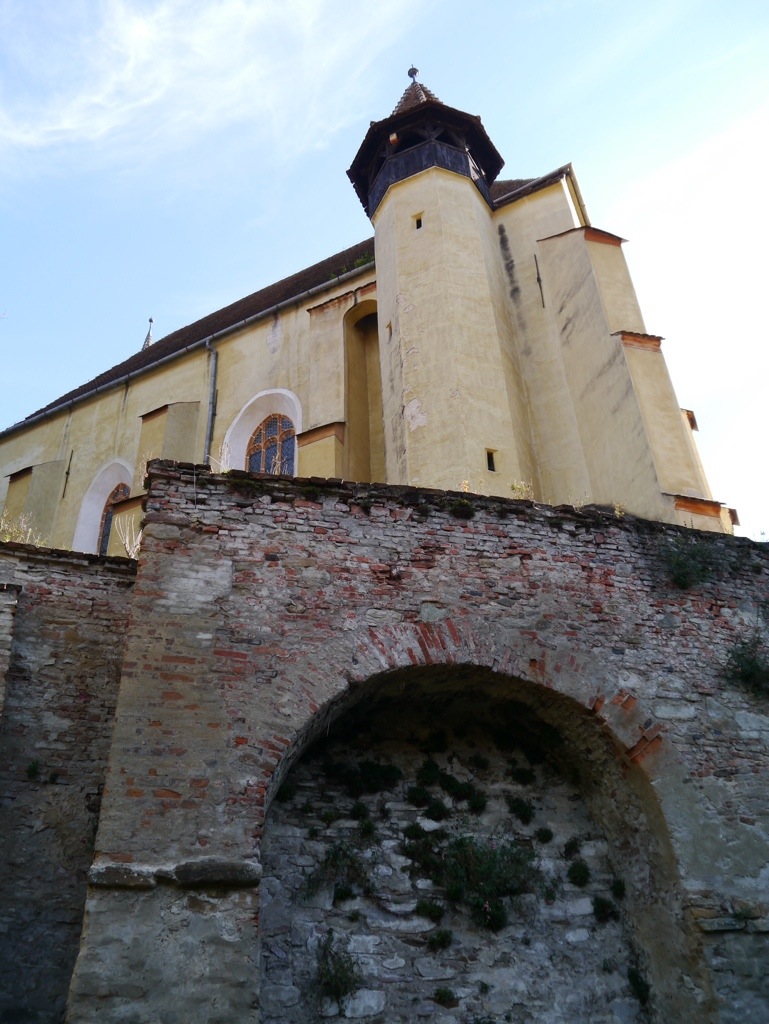
Lexx and I plunged into the thick of Transylvania by touring Biertan, a commune of three villages (including Copsa Mare, where we spent the night). Biertan is famous for its ancient fortified church, a UNESCO World Heritage site. And man is it ever creepy …
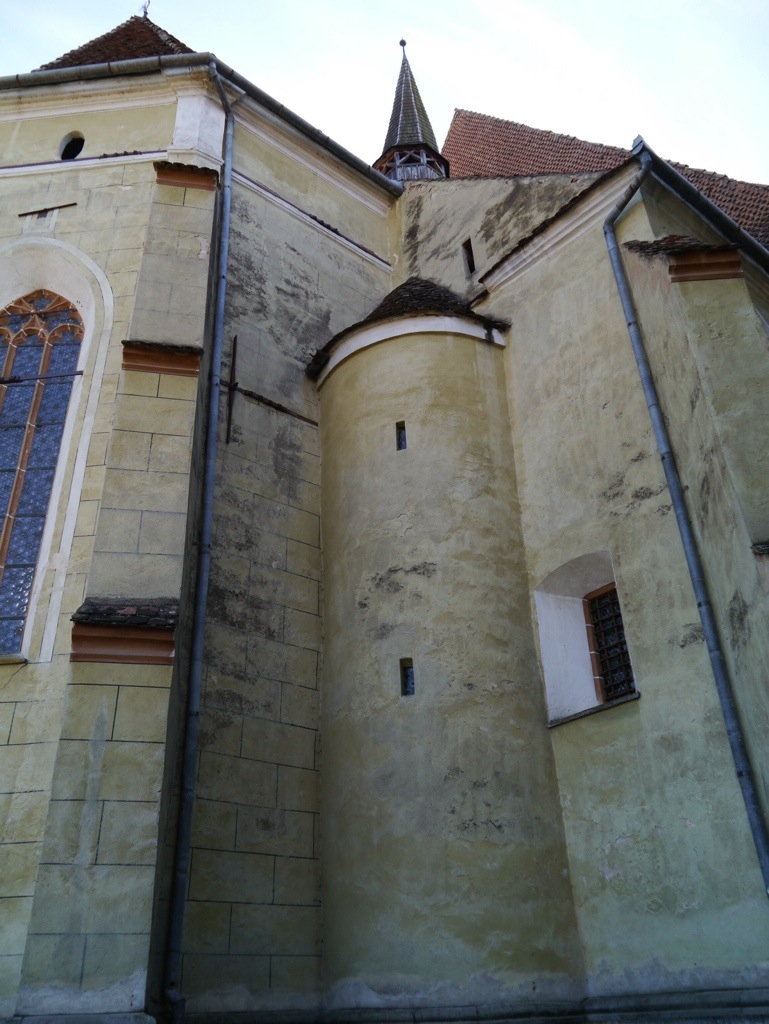
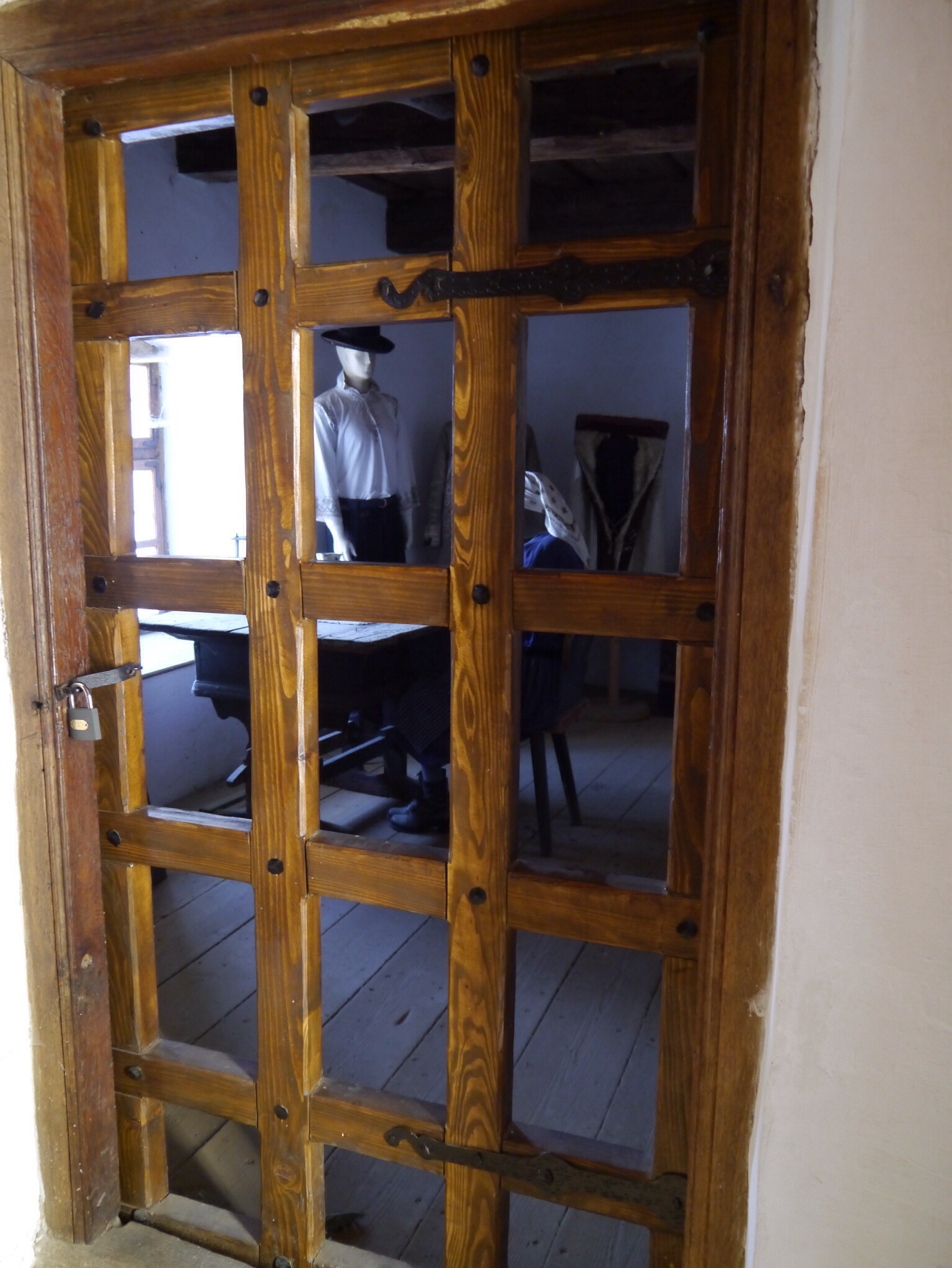
The 15th-century church is the former site of the Lutheran Bishop, who had an interesting (and highly effective) method of dissuading would-be divorcees by locking them in a room for two weeks with one bed, table, chair, and set of cutlery, along with Barry White’s complete discography.
We’ve been very fortunate all week with some gloriously crisp and sunny fall days. Despite the relative warmth outdoors, the interior of this church was easily 20 degrees cooler (a sign of vampires?), its thick walls effectively silencing the external environment.
Another notable feature of the church is a sacristy once used to store treasures which were protected by a door with an intricate 19-lock system. The door’s engineering won first prize at the 1900 Paris World Expo.
After our visit we made the short drive to Copsa Mare, where an interesting experiment in cultural preservation is underway. Two Italians moved to the village several years ago to start a nonprofit dedicated to protecting rural Transylvanian culture. Much of their work is funded by revenues from restored properties that are now guest houses for tourists like us who wish to experience the calming pace of Romanian village life.
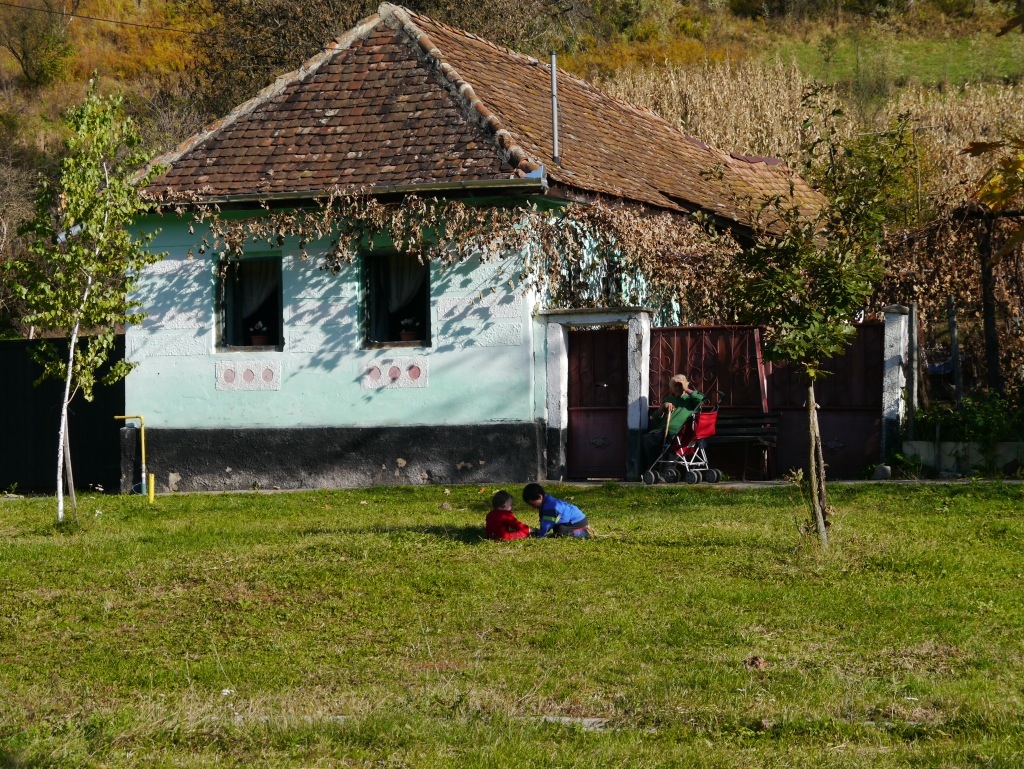
Copsa Mare is located in one of the most picturesque settings imaginable, teeming with the sights and sounds of centuries ago. Upon check in, our host arranged a horse cart ride that took us on a winding journey through the countryside to a hilltop overlooking the surrounding valley, with the Carpathians looming regally in the distance.
After a couple of hours absorbing the view, we made our way back to Copsa Mare for a delectable home-cooked meal of braised lamb, potatoes, and soup, all fresh off the farm. Night had fallen by the time we finished our last serving of tuica, and as you might imagine, the Transylvanian sky puts on quite an astral show being so far removed from the big city lights. Indeed, the Milky Way was clearly visible along with whirring satellites and even a shooting star. In moments like these, the idea of dropping everything and moving to Romania for the “simple” life doesn’t seem so crazy.
The next day Lexx and I made our way to the medieval town of Sighisoara, the birthplace of Vlad “The Impaler” Tepes (aka the inspiration of Dracula). Sighisoara’s main historical sites are all within the small citadel overlooking the lower town and valley. It definitely punches above its weight, with photo opportunities from all directions and vantage points. From the Church on the Hill (circa 1345) to the Clock tower (circa 1280) and Covered Staircase (circa 1642), Sighisoara may be the one place in Romania that captures the visual impressions that draw most people to the country in the first place.
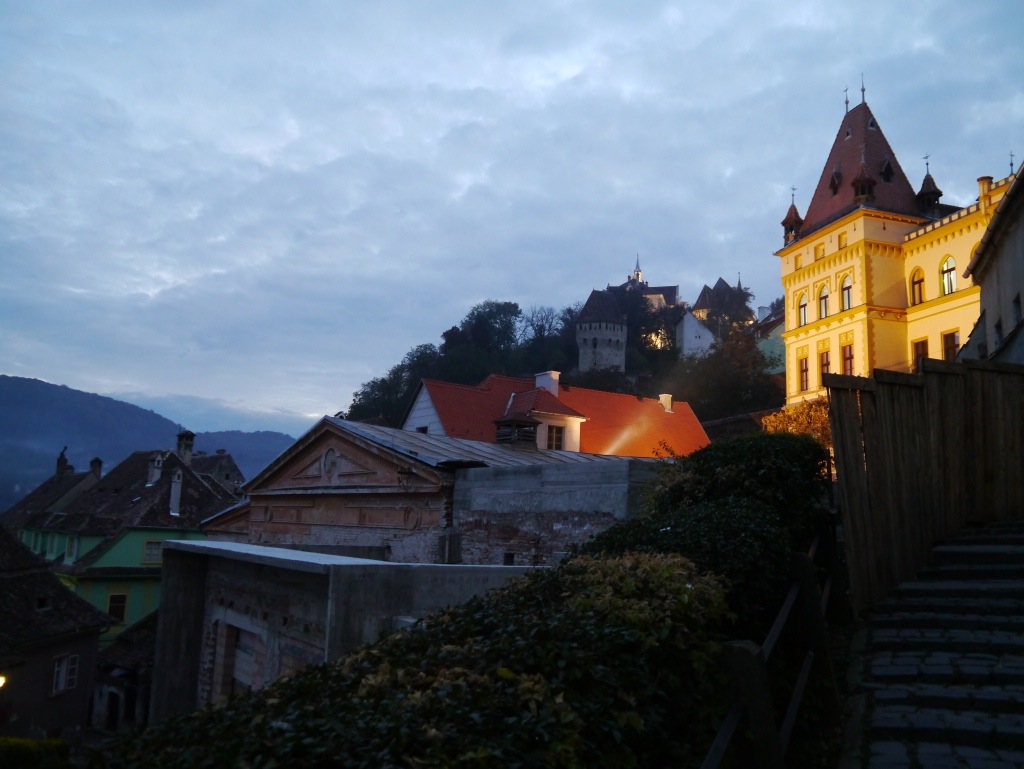
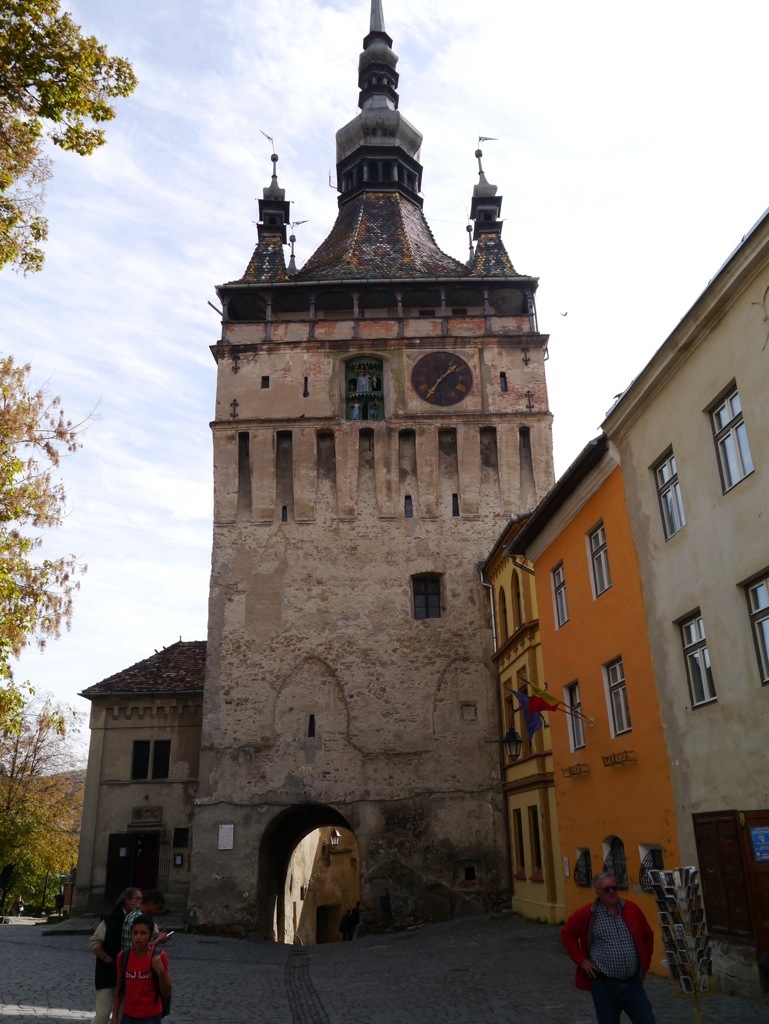
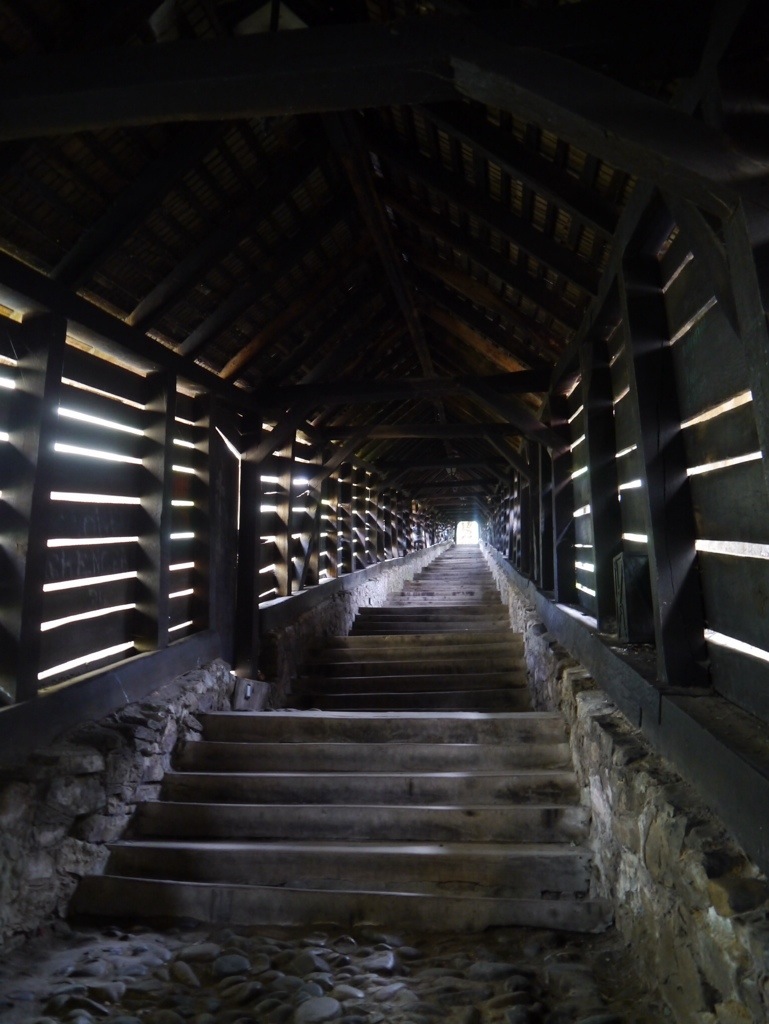
For reasons that are still unclear, at this point in our journey my body decided it was time for a “reset” (I’ll spare you the gory details). So we retired to our rustic old pension after an early dinner, capping off the night with a couple of tuicas at one of the most stunning hotel bars I’ve ever seen. And that’s really saying something …

Sibiu
October 7, 2013
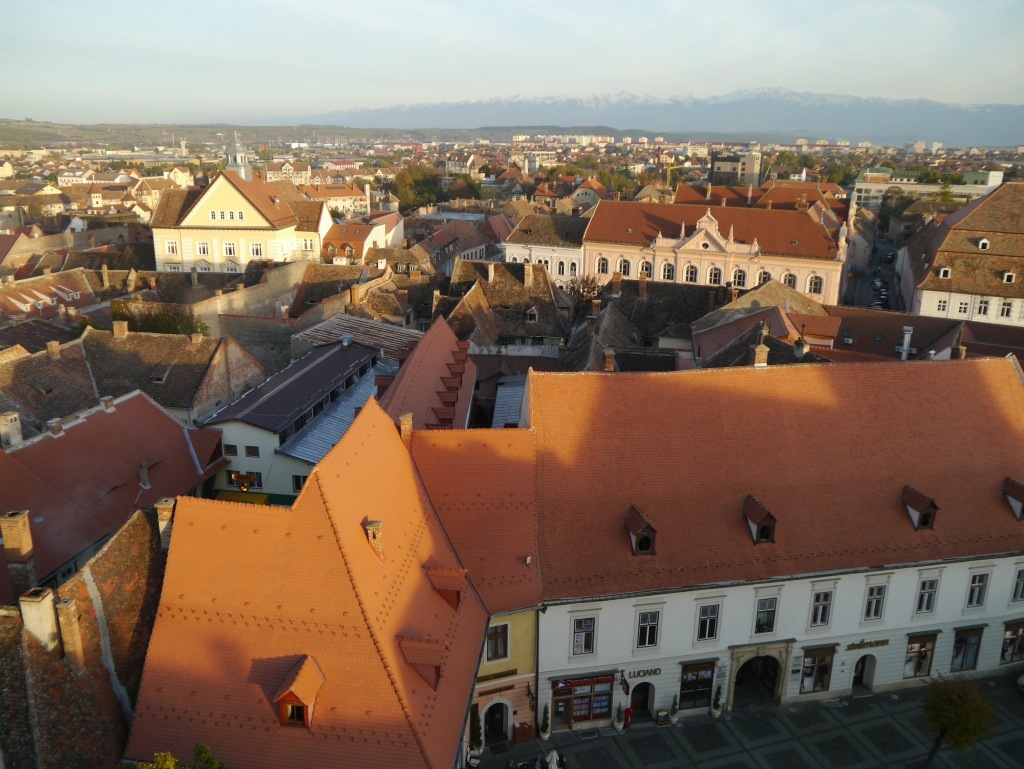
Today we took a train to the Transylvanian city of Sibiu. In 2007, the EU decreed Sibiu to be a “European Capital of Culture.” Nowadays, Sibiu looks very smart, especially its medieval gem of a town center.
For the first time of this trip the hotel staff didn’t quiz us about matrimonial beds. And for the most part Lexx’s skin pigmentation escaped attention, aside from a girl selling pretzels who apparently was too shy to serve him.
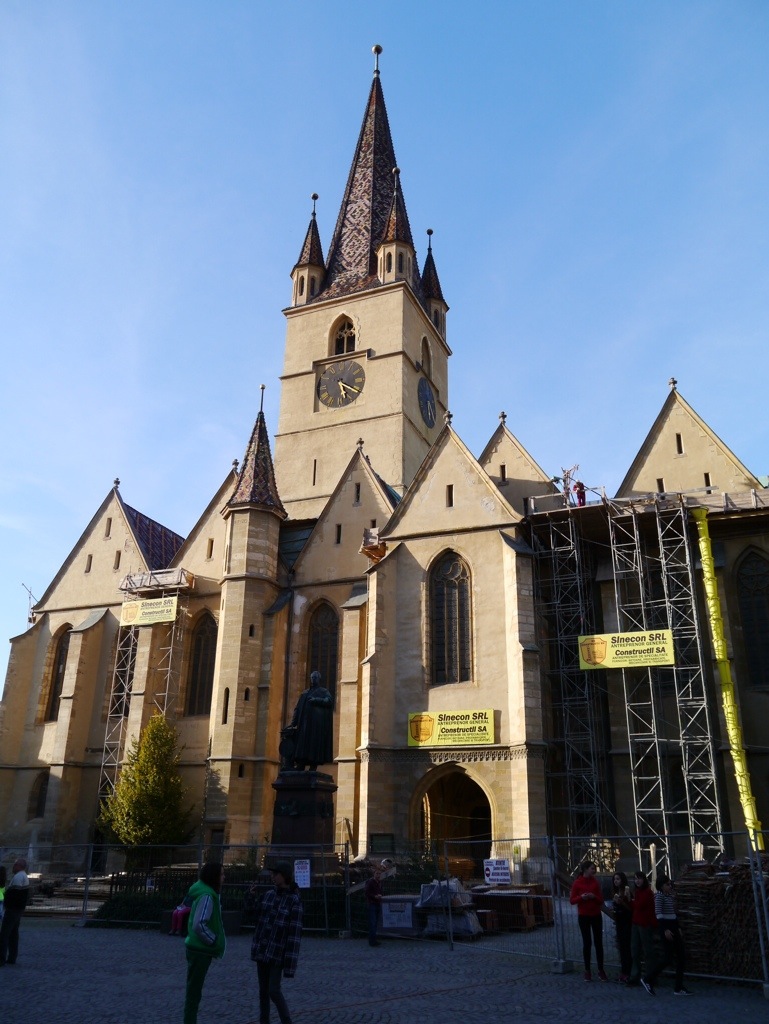
There is a significant German minority presence in Sibiu, at the heart of which towers the immaculate Lutheran Cathedral. Dating to the 12th Century, the church’s four spires were a warning to foreigners that the city had the power to administer the death penalty. Fair warning.
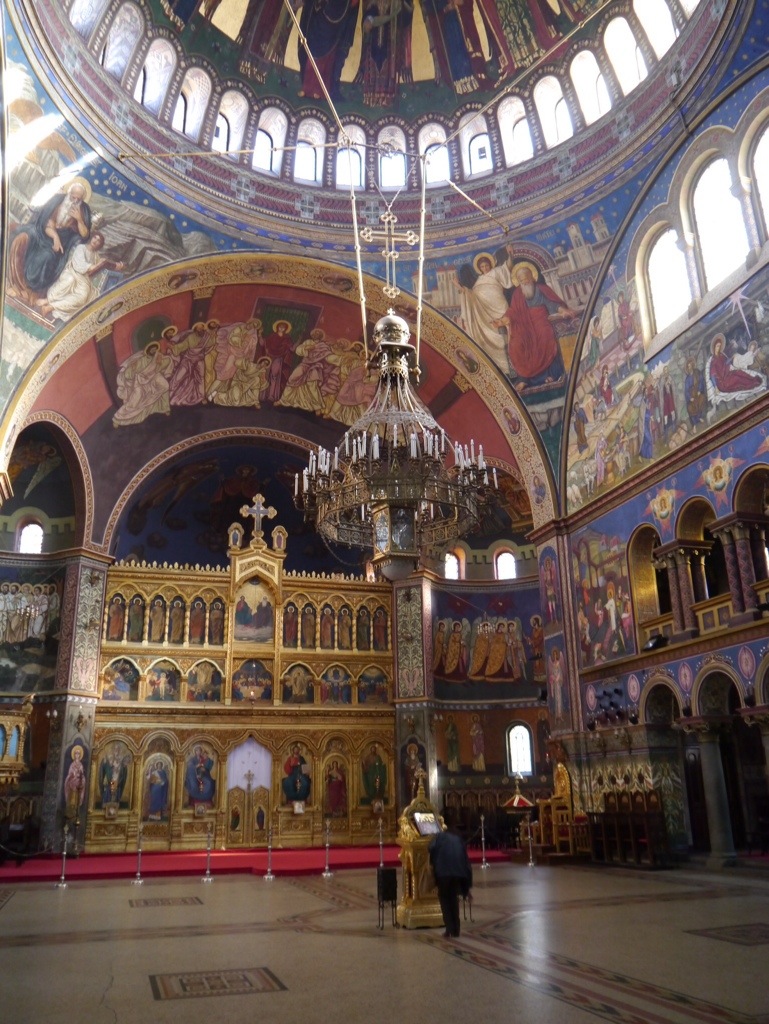
Just a few minutes walk away is another impressive religious site: the Romanian Orthodox Cathedral. Although built in 1900, the church exudes an ancient solemnity with one of the most dazzling interiors imaginable. If you’ve ever been to Istanbul (not Constantinople), you’ll recognize the architectural resemblance to the Hagia Sofia.
Even though it was a Monday, the street life was still buzzing at all hours. After a couple of stops to sample the pub offerings, Lexx and I made our way to Crama Sibiul Vechi, a smoky cellar restaurant serving heaping portions of Romanian food. Once again, we were amazed by how inexpensive even the high quality restaurants are in Romania: two appetizers, two entrees, a bottle of Romanian wine and two large tuicas for 90 lei ($30)!
Stuffed out of our pants, we decided to walk off dinner by exploring the tiny, meandering lanes of a medieval residential district close to our hotel. Along the way, and purely by chance we happened upon a tiny pub that was hosting a three-piece rock band from Hungary. The lead singer definitely had his act down pat, sporting a Rob Thomas hair style and a tight tank top to show off his pecs and guns. The crowd was really into it, especially a couple of old alcoholics sitting at the bar.
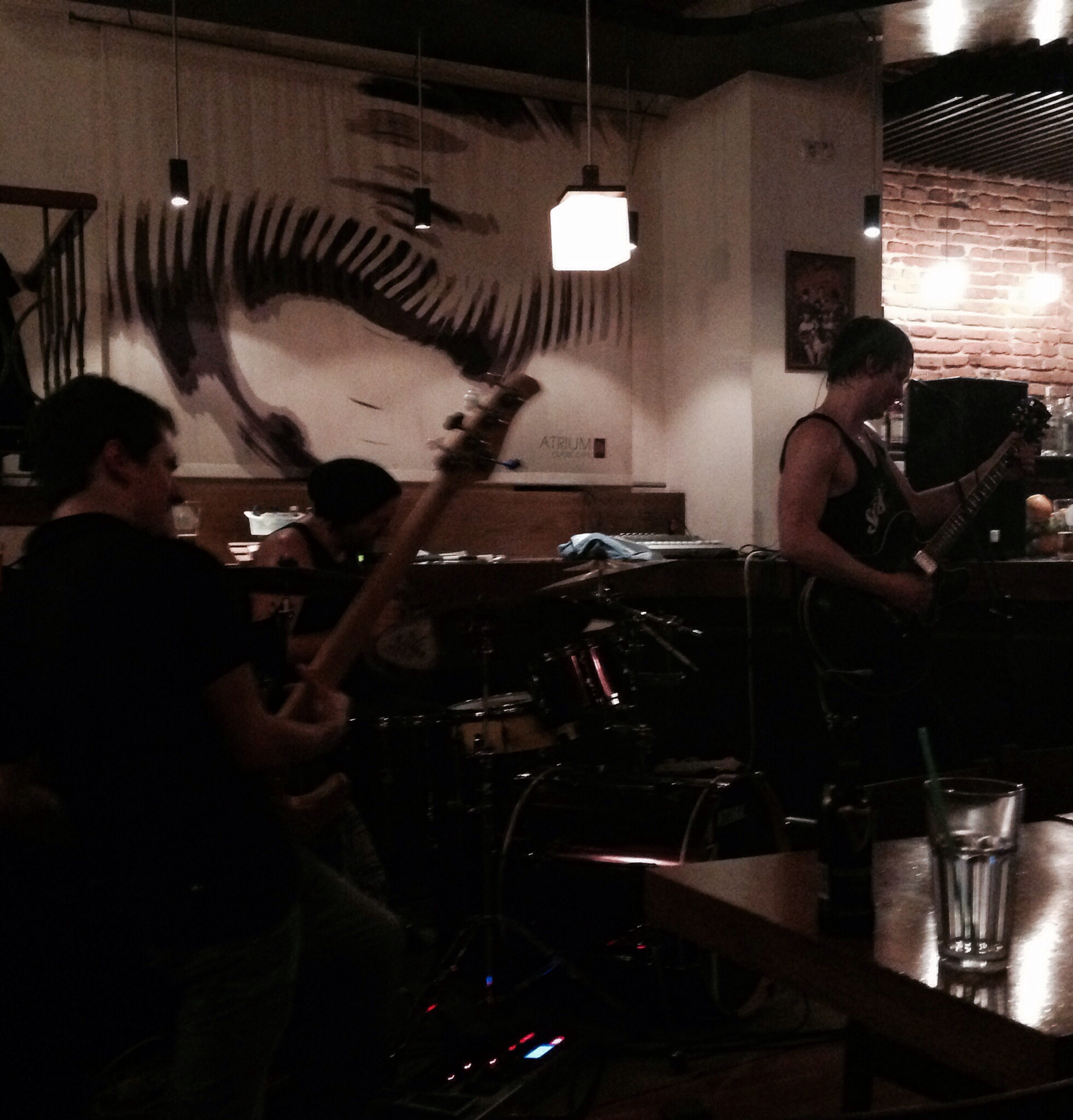
And for the record, I’m not referring to Lexx and myself!
Tomorrow we are leaving city life to spend a night in an actual Romanian village, where apparently only men are permitted to drink inside the lone bar.
Will Lexx and I turn out to be the only gays in the village? Stay tuned!
Brasov
October 6, 2013
After surviving a night of tuica and earthquakes, Lexx and I made our way to Gara de Nord to catch a train bound for Sinaia. The train itself wouldn’t be confused with the Orient Express, but it did leave on time and remained intact for the 90-minute journey.
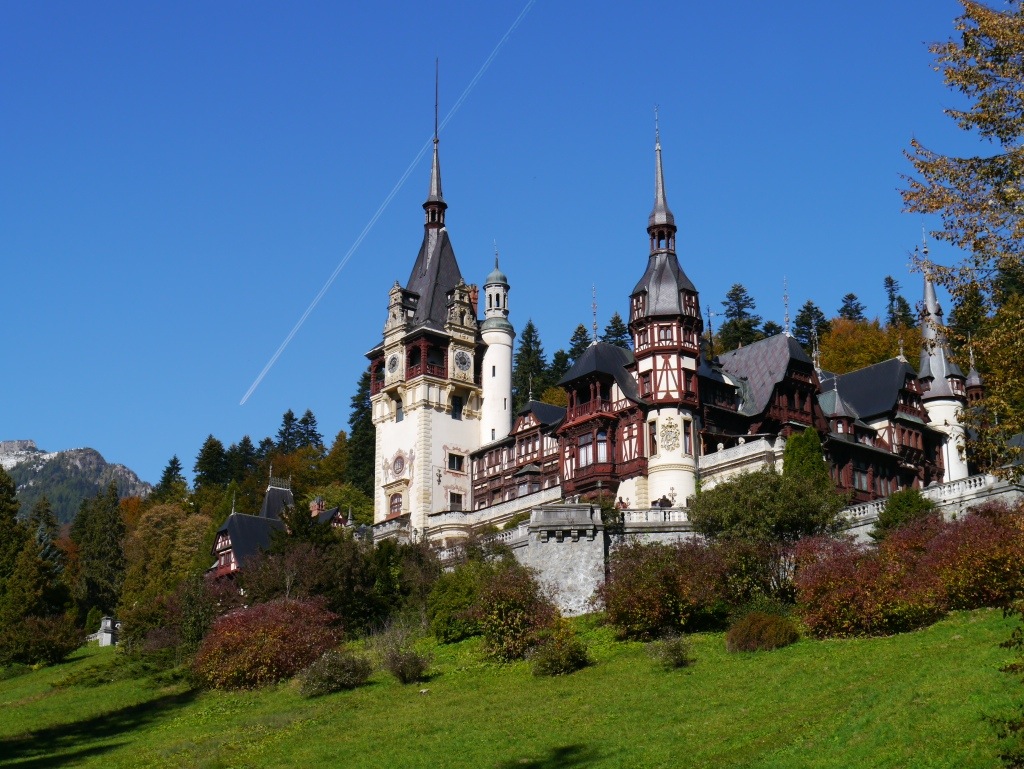
Sinaia is a resort nestled in the Carpathian Mountains, a visually stunning range of jagged, snow capped peaks that rival the Rockies for sheer majesty and beauty. At the station we met a driver who our hotel had arranged to transport us to two key sights en route to Brasov: Peles Castle and Bran Castle.
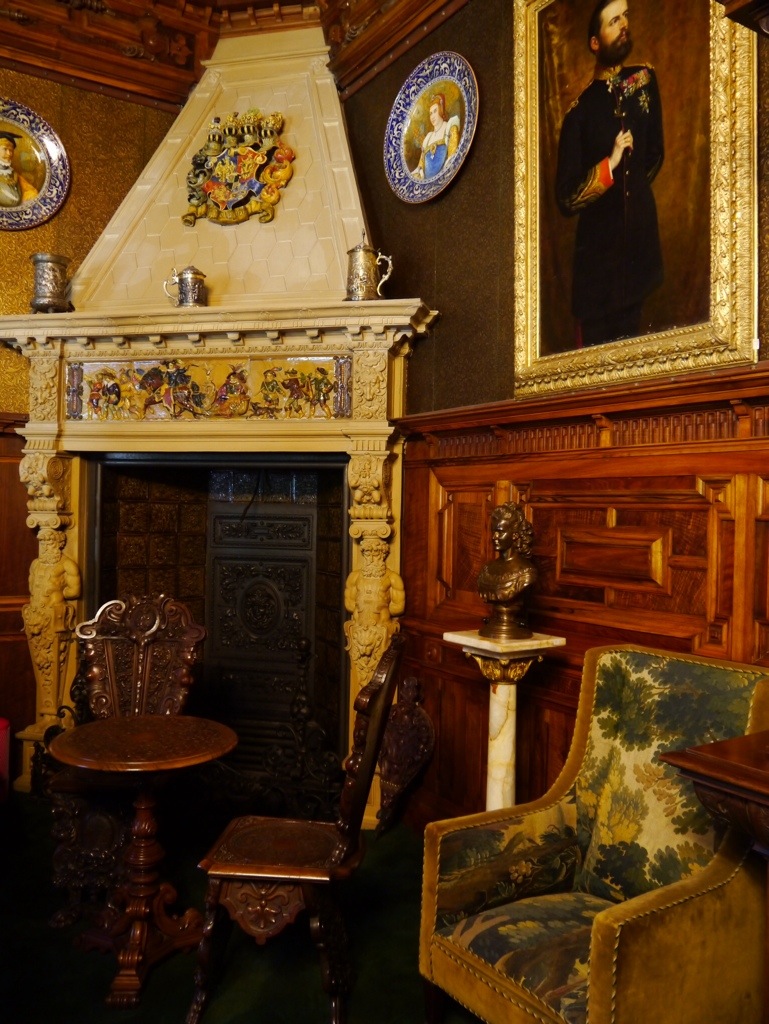
Peles Castle was built over a 40 year period as a resort for King Carol I, with the keystone laid in 1873. At the time it was renowned for its advanced technology, boasting indoor electricity (the world’s first castle to have it) and a vacuuming system. Today, a visitor is likely to be more impressed by the breathtaking craftsmanship and eye for design that went into the intricate wooden staircases, glass chandeliers, frescoes and art.
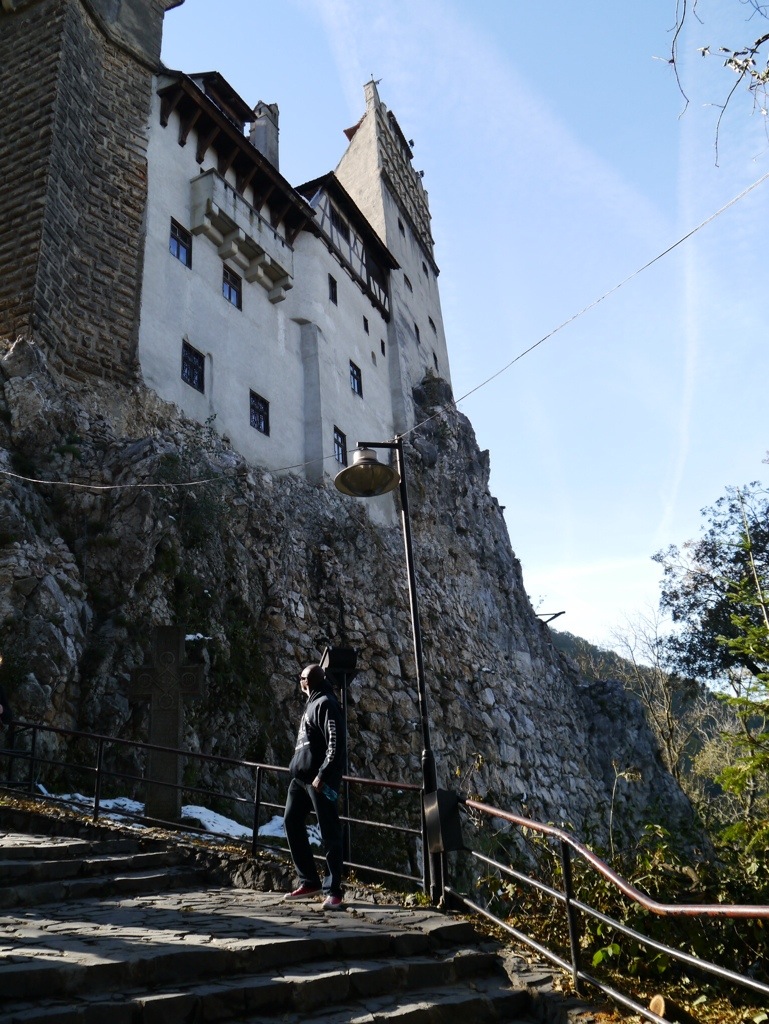
After a couple of hours we made our way to Bran, the closest thing in Romania to a typical tourist trap. The main attraction, Bran Castle, hovers menacingly over a small town full of little shops selling all manner of bric-a-brac and lousy fast food.
Bran Castle has been nicknamed Dracula’s castle because of how closely it resembles Bram Stoker’s description of the Count’s abode. In reality, there is no evidence that Vlad Tepes, the “Impaler” who inspired the Dracula mythology, ever resided at the castle.
Built originally for defense against invading Hungarians and Moors, Bran Castle eventually became home to German royalty who moved to Romania. Thankfully, most of the castle reflects it’s actual heritage, minimizing the blood and bats (this was a real disappointment for many of the school groups swarming the castle grounds).
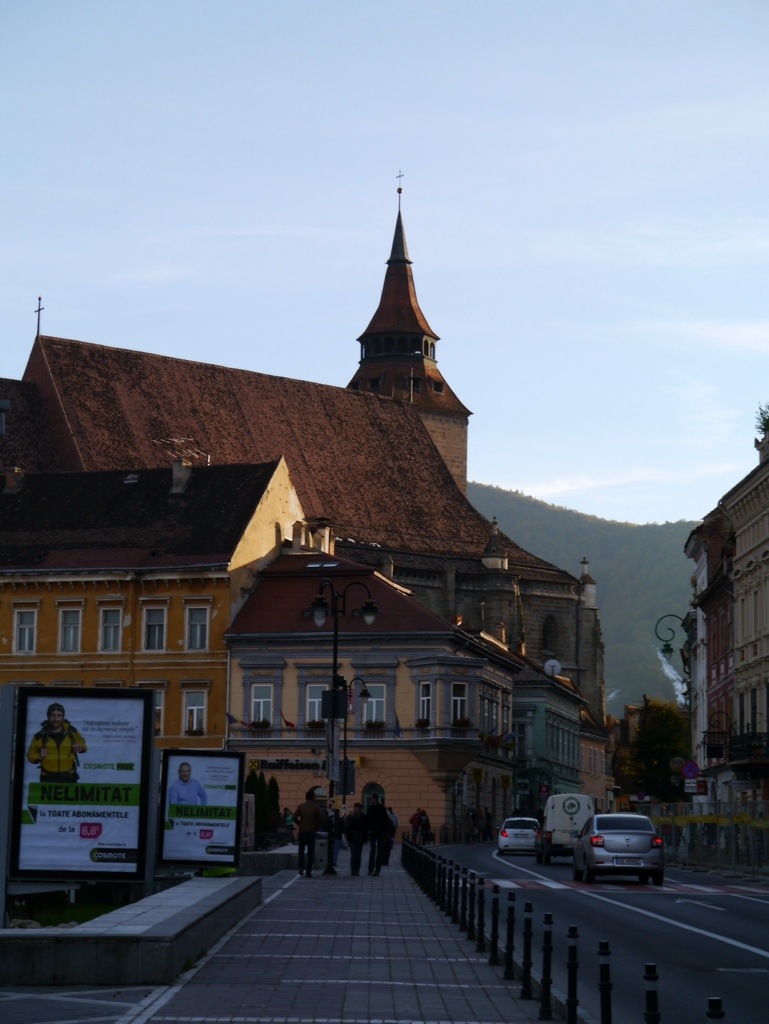
Having had our fill of grand palaces, we made our way to Brasov. The city is popular as a base from which to visit some of Romania’s famed ski resorts, but tourists come year round for its charm and small-town feel. Lexx and I arrived in time to see some amazing historic sites, foremost being the Black Church. Nearby in the cute town square was a large farmer’s market with dozens of vendors selling arts, crafts, and Romanian food.
While we loitered in the square, a loud and rambunctious group of protestors passed by carrying banners and beating drums. Lexx remarked that they were unhappy about the black guy in Brasov (he had received curious looks from passersby earlier in the evening). As it turned out, the protestors were agitating against the government’s plans to round up and euthanize the packs of wild dogs roaming the streets of most Romanian towns and cities.
After some pub hopping we decided it was time for dinner. Eventually we found a restaurant named Festival, a relatively large space with crazy decor straight out of Moulin Rouge. Minutes after being seated a gentleman approached our table.
“Excuse me,” he said to Lexx. “Would you come have your picture taken with my friend? She is a bride-to-be and thinks your skin would make a nice picture for the contrast.”
Lexx let that sink in for a few seconds before declining politely (but firmly).
For the most part we enjoyed our meals (and the Romanian pinot noir definitely helped us forget about the village idiot). We opted to skip dessert in favor of some tuica, but the waitress instead offered us two shots of Vilmos, a floral digestif that didn’t seem to pack as much firepower as tuica, yet actually was at least as potent judging by the way I was slurring my speech once we got back to our hotel.
Well, you tell me …
br />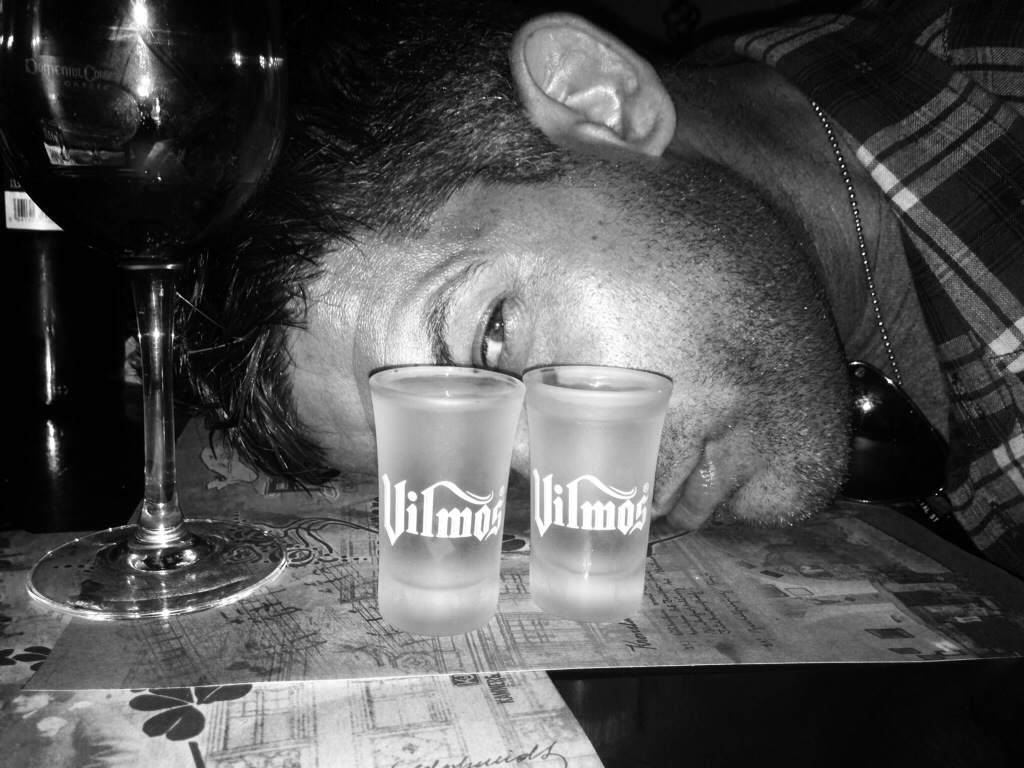
Bucharest
October 5, 2013
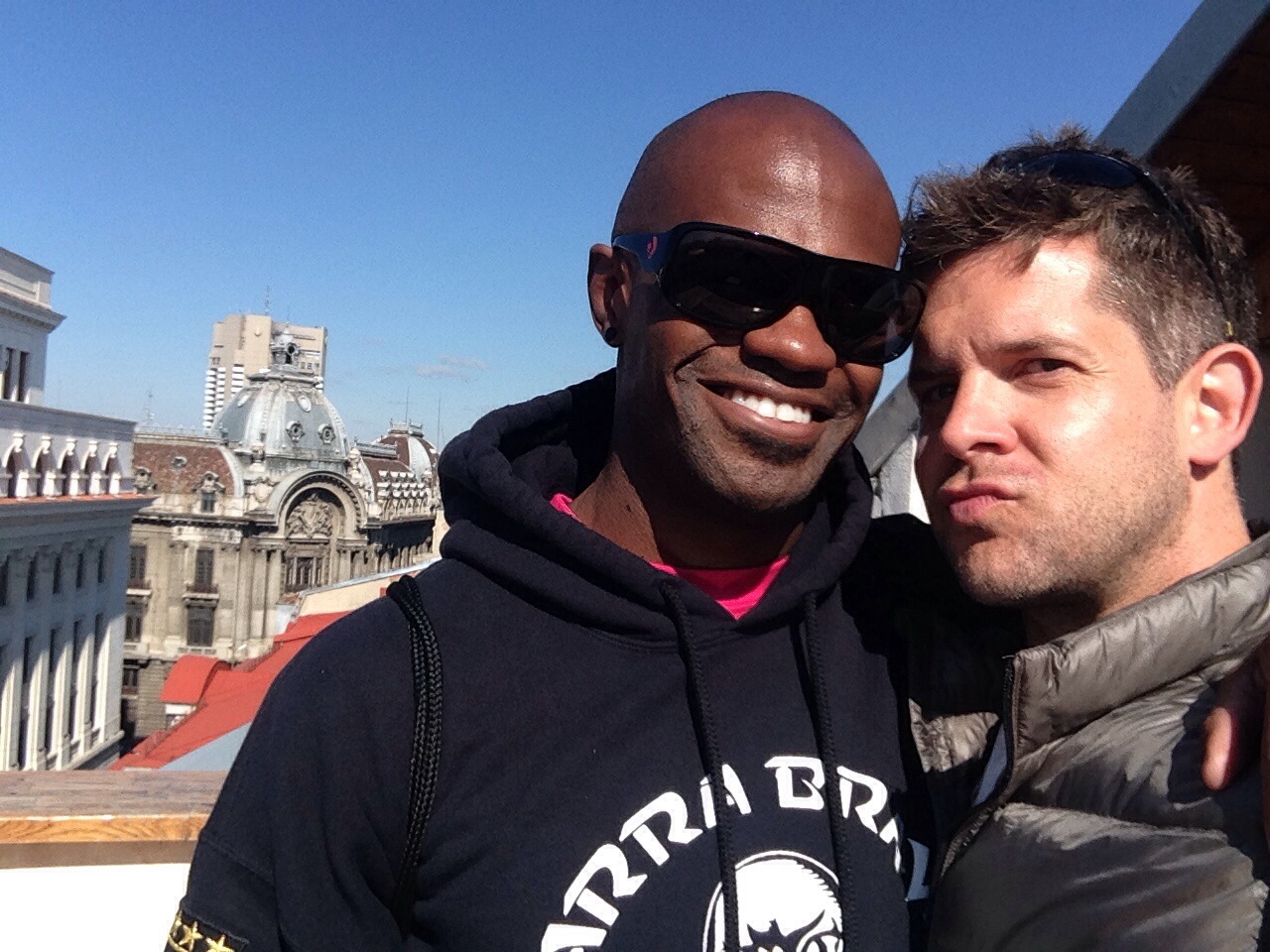
Lexx and I arrived in Bucharest in the early afternoon on a sunny, crisp fall day. “Welcome to the Hotel Rembrandt,” said a smiling young Romanian lady. “May I have your passports, please?”
Lexx and I handed over our travel documents. “One moment,” our clerk said as she disappeared into a side room.
Gazing around, I admired the modern artwork of the hotel’s lobby and the crowds enjoying coffees and beers in the outdoor cafés lining Strada Smârdan. After a few minutes, the clerk reappeared.
“Mr. Solem? I have your room key. You are in room 71 on the top floor.”
“Thank you,” I replied.
“But, you are two guys, and there is one bed,” she said timidly. I glanced at Lexx.
“It is a lovely room,” she continued. “It comes with a small balcony overlooking Old City, but I think you will be happier in a larger room with two beds. It will be an additional 15 euro.”
Riiight.
“Oh, we’ll be fine,” Lexx said. “We’re only here one night.”
The clerk looked at us, plainly confused. “But, uh … it’s a matrimonial bed … if you like I can make an extra set of bedding?”
We laughed and picked up the room key from the desk. Gesturing at Lexx, I said “I’ll just make him sleep on the balcony.”
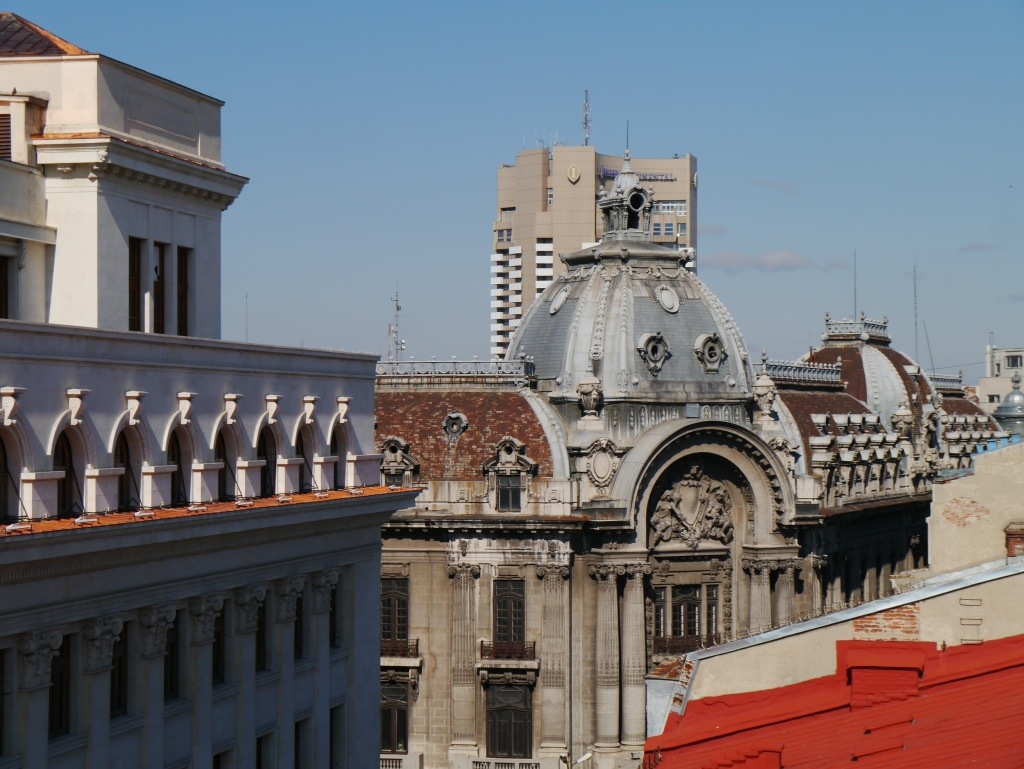
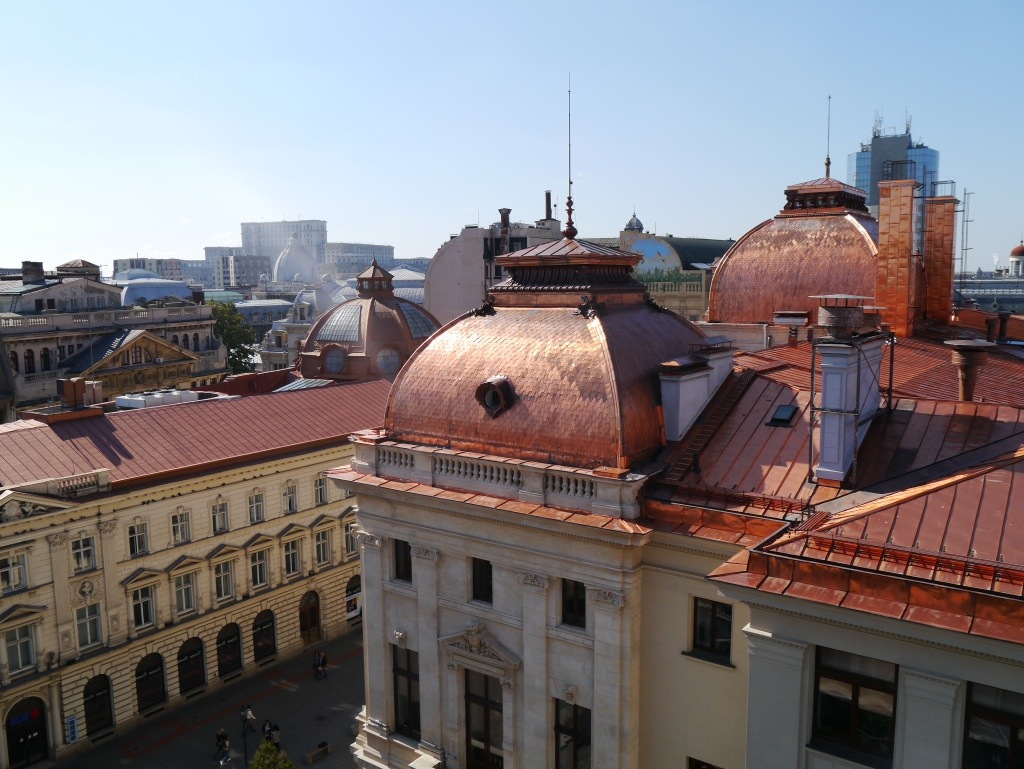
View from our balcony at the Hotel Rembrandt. The copper-domed building is the National Bank of Romania.
With that as our introduction to the Romanian capital, Lexx and I quickly unpacked and ventured outside to take advantage of the remaining daylight hours. The Old City is a quarter in Bucharest that has enjoyed significant revitalization in recent years. During Communist rule under Ceaușescu, the Old City was long a neglected zone full of squalid apartment buildings and very little in the way of nightlife and tourist attractions.
Now relatively flush with cash following a fitful transition to capitalism and EU membership, Romania has invested significant funds to recreate Bucharest as a tourist destination. The cobblestoned streets of Old City have benefited greatly as dozens of new restaurants, bars, shops and clubs have opened, while new residents have poured in.
Old City still has plenty of grit and many buildings appeared to be abandoned. Still, the quarter provides much more charm than the brutally grey, squat buildings that dominate much of Bucharest’s streetscape. Tucked away off a side street near the Hotel Rembrandt are two Christian churches dating from the 17th century. Both featured faded yet lovely frescoes, pleasant gardens and a solemn profile that contrasted with shiny office buildings that are cropping up on a seemingly daily basis. Apparently there’s not much time for urban planning in this rapidly modernizing Eastern European city.
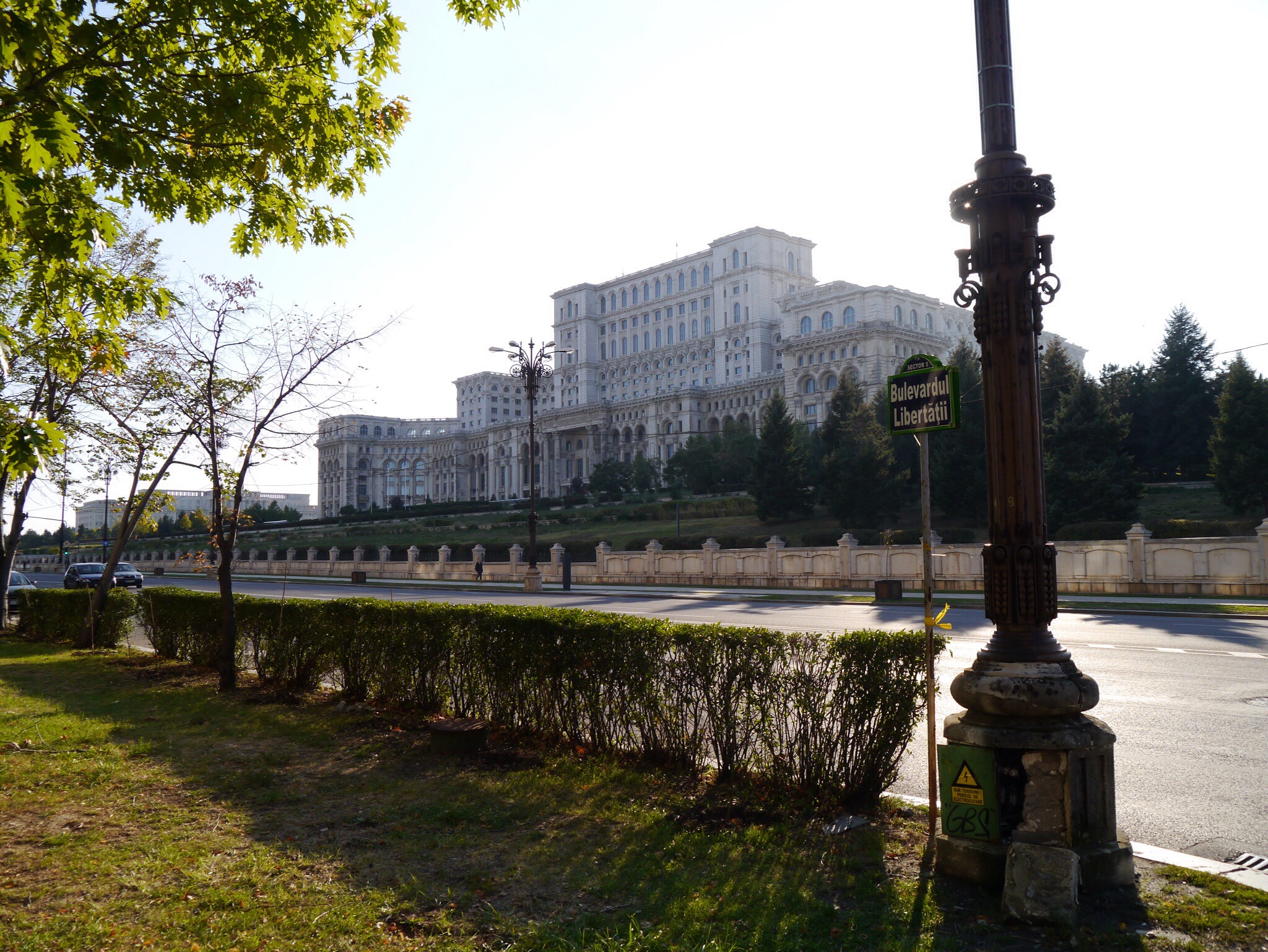
The Palace of Parliament, sans hanging Ceaușescu
Returning to our hotel, we asked the clerk for a restaurant recommendation. Without hesitating, she suggested Lacrimi si Sfinti (“Tears and Saints”) located a mere 5 minutes away. It’s the kind of authentically local place that upon arrival immediately sets your senses reeling: no masses of tourists, waitstaff in traditional clothing with modern twists, roving musicians playing violas and guitars, a 6’8″ hulk of a doorman with a disarming smile, lots of exposed beams and candles, and an open kitchen from which all sorts of goodness flowed.
Lacrimi si Sfinti offers a wine experience beyond compare, with an impressive list of whites and reds from the owner’s personal vineyard. We selected the Cabernet and it was a perfect accompaniment to my goose, lamb and white bean stew and Lexx’s ram pastrami and polenta. To conclude our feast, the waiter brought us two vials of Romanian tuica. A digestif, the experience of drinking tuica pretty much like drinking paint thinner. Still, I’m sure we’ll acquire a taste for it by the time we come home.
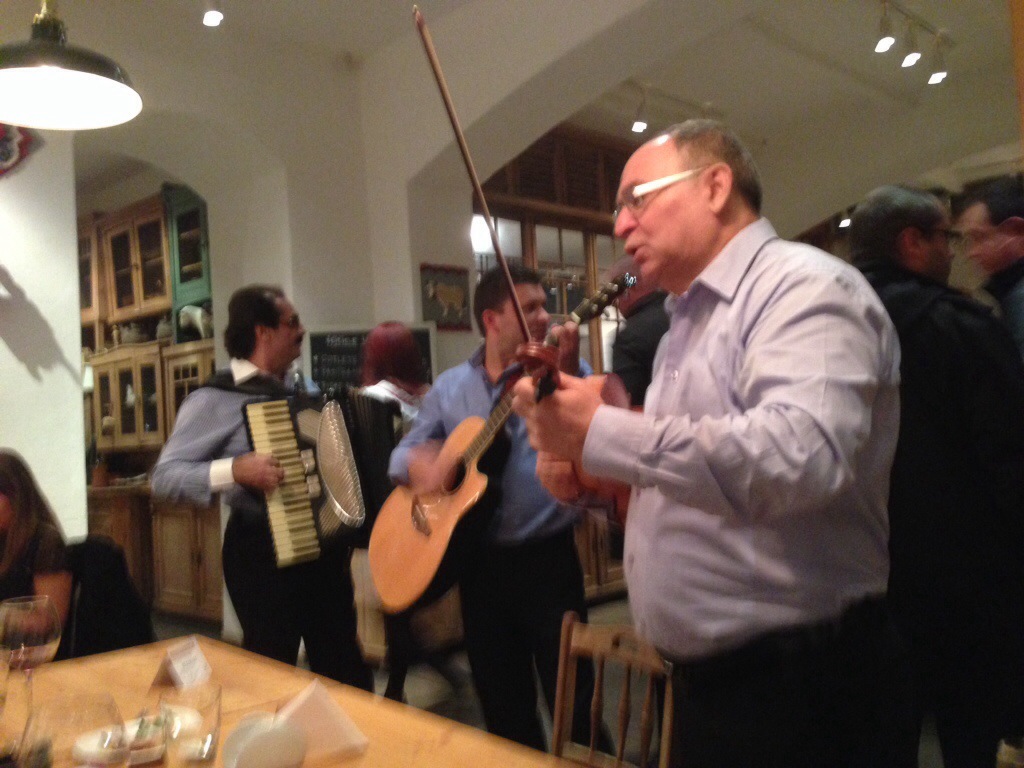
the house entertainment at Lacrimi si Sfinti.
After dinner we drug our satiated asses to a chill, smoky lounge called Atelier Mechanic. There we met a theatrical young boy performing card tricks and enjoyed some remixes of Leonard Cohen songs over 20 oz bottles of beer — at $2 each, this night easily could have spun out of control.
Showing our age, we decided to call it a night and made our way back to our hotel, where our matrimonial bed was waiting. After a quick nightcap on the balcony, we effortlessly fell asleep.
And then, this happened …
EARTHQUAKE YO!!!!!
Good thing we had some tuica to take the edge off.
Up next: Brasov
 michaelsolem.net